Bridges and Baskets: The Pelvis (Part II)
A SERIES EXPLORING THE ANATOMY OF CONNECTION + SUPPORT

Welcome to Bridges and Baskets, a series exploring the anatomy of connection and support. My hope is to illuminate the cooperative nature of our bodies - tracing the organic shapes and patterns of the human form through a morphological lens, and nurturing a more narrative understanding of ourselves as living expressions of Nature herself.
Welcome back to Bridges and Baskets: structures that support and connect! Last post we wandered and wondered at the sociological and anatomical frame of our pelvic bowl. In this post, we meet the responsive, breathing fabric of our pelvic floor.
Anchored into the pubic rami at the front, the sit bones at the base, and the sacrum and coccyx at the back, this muscular diaphragm forms a dynamic foundation for everything above it. It cushions our steps and breath, supports our organs, participates in continence and sexuality, and adapts continuously to the shifting demands of daily life.
Unlike the steady and stable solidity of bone, this basket is alive with change. It yields and recoils. It descends and lifts. It listens.
And as we begin to explore this terrain, we move from structure into relationship, from architecture into conversation.
If we imagine the pelvic floor as a basket, it is not a single sheet of muscle but a layered weave; depth upon depth, each strand contributing something slightly different to the whole.

Closest to the surface are the muscles many people are most familiar with: the ones we might sense when we gently engage or release the pelvic floor. These include voluntary sphincters for the urethra and anus, while others aid in sexual function This layer relates closely to the thresholds of the body… what opens and closes, yields and contains.
Beneath this lies a sturdier but still responsive layer, sometimes referred to as the urogenital diaphragm, so named for its role in supporting the urinary and reproductive structures above it. Emphasis here is on structural continuity - distributing forces across the pelvis. This middle weave helps translate the movements of walking, breathing, and shifting weight into coordinated support.
At the innermost level we meet the levator ani group. These muscles form the inner cradle of the basket, lifting and supporting the pelvic organs. They also participate in something more relational: coordinating with the breathing diaphragm, responding to intra-abdominal pressure, adapting to load, posture, and movement.Rather than thinking of these layers as stacked like floors in a building, it may be more helpful to sense them as interwoven - a dynamic fabric that thickens, thins, yields, and recoils; collaborating in response to what is asked.

Rather than holding all of this as information, you might pause for a moment.
If it feels comfortable, place one hand gently over your lower belly and the other at the back of your pelvis… somewhere between your sacrum and your low ribs. No need to press or perform. Just making contact.
Without changing your breath, notice what is already happening.
As you inhale, is there a subtle widening or softening beneath your lower hand? A yielding into the back of your body? Or perhaps very little that is perceptible at all.
And as you exhale, is there a gentle recoil… a gathering, a buoyant lift, or simply a settling?
There is no correct sensation to discover. The invitation is only to notice.
Just above and to the back of the pelvic floor basket lives another important participant in this conversation: the psoas major. This deep core muscle travels from the lumbar vertebrae through the pelvis to attach onto the inner, upper thigh bone. Because of her position, she forms a kind of muscular corridor between spine and leg - influencing how we stand, walk, and organize ourselves in gravity.
The psoas is often described as a hip flexor, but that label barely captures her relational role. She helps stabilize our lumbar spine, modulates pelvic orientation, responding continuously to changes in load, breath, and movement. Rather than forcing the pelvis into a fixed tilt, she participates in subtle adjustments… sometimes lengthening, sometimes shortening… depending on what is being asked of our body.
Above dear psoas arches our primary breathing muscle: the dome-shaped diaphragm. Our diaphragm attaches along the lower ribs and lumbar spine, sharing fascial and structural relationships with the psoas. They are close neighbours, linked not just by proximity but by function.
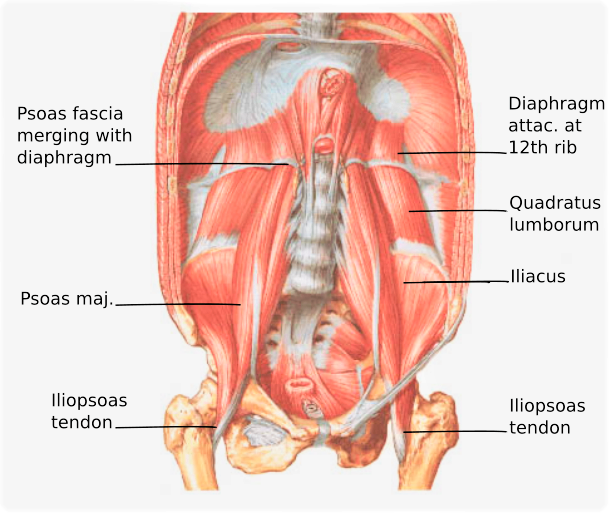
As we inhale, the breathing diaphragm descends, making space for the lungs to fill. Exhaling, by contrast, is largely a passive process - an effortless recoil, a releasing of what was held. Ideally, the pelvic floor responds with a gentle yielding - a widening or softening that accommodates changes in internal pressure. On exhale, both diaphragms rebound and reorganize, engaging in a call and response dialogue, rather than following a rigid script.
Let’s explore this relationship a little more intentionally.
Come to stand with your feet roughly hip width apart, knees soft, arms relaxed at your sides. Close your eyes if that feels comfortable, or soften your gaze toward the floor. Take a moment to feel your feet on the ground… the heel, the ball, the toes. Notice the floor rising up to meet you.
Begin with a gentle bounce… just enough to feel the body's natural buoyancy. Not a jump, more of a soft yielding through the knees and ankles. Let your weight shift and settle. Can you sense your pelvic floor responding to this movement?
Bring your awareness to the bony landmarks of your pelvis. Can you sense your sit bones? Even whilst standing, there is a subtle awareness of them below you. Encircle your fingertips around the ilia or wings of the sides of your pelvic bowl. And now gently place your thumb in your navel and extend your index finger to the floor… contact your pubic symphysis at the front of your pelvis. Release your arms back to your sides and offer yourself a moment to appreciate the three dimensionality of your pelvis. Between these bony anchors the “basket” of your pelvic floor is suspended. Alive, responsive, supporting.
Now simply breathe. On each inhale, can you sense a subtle widening through the base of the pelvis? Allow a gentle arch in your lower back, a softening through your abdomen. On each exhale, a gentle recoil and lift? Begin a slow, small pelvic rock: tipping the basin of your pelvis forward on the inhale, releasing back on the exhale. Let gravity be your teacher here.
This chat may take you in some unexpected directions - literally. There may be swirls, dips and rolls. Perhaps your legs join in the fun! I encourage you to follow the lead of your body and continue on until the movement feels complete.
In this way, the pelvic floor and breathing diaphragm are in ongoing exchange; attentive partners adjusting to one another moment by moment. Each breath becomes an animate crossing - bridging inner and outer, effort and ease.
“All flourishing is mutual.” -- Robin Wall Kimmerer



Comments